
Turn Your Dealer Network Into a Local Revenue Engine
D2C helps brands build and understand which dealers are driving growth, which are losing buyers, and what to fix to improve local conversion, trust, and sell-through.
- Identify underperforming dealers fast
- Improve local conversion market by market
- Reduce buyer friction and trust gaps
- Prioritize support and co-op with confidence

Positioning
Built for brands that grow through dealers, distributors, and local retail partners
If your revenue depends on independent partners turning brand demand into local sales, your marketing has to match Ideal Customer and Offer, account for what happens after the lead leaves your hands. D2C is built specifically for that reality.
The Real Problem
Most dealer marketing creates activity, not accountability
Brands invest heavily in dealer marketing, co-op funds, and local campaigns, then struggle to answer the questions that actually matter: which dealers are converting local demand, which markets are underperforming, and where buyer friction is quietly costing sales.
Your Brand + your Dealers Brand together create a Unique Selling Proposition. This Ideal Customer is market dependent and need to be uniquely nurtured. Seeing whether a buyer trusted the dealer enough to act, or walked away before the sale closed, is not available in conventional content engines. That gap is where growth gets lost, and it's the gap D2C is built to close.
The Shift
Two ways to run dealer marketing
One measures whether content went out. The other measures whether it moved a buyer to act.
Traditional Dealer Marketing
- Content gets distributed to dealers
- Participation varies dealer to dealer
- Reporting stays surface-level
- Performance gaps stay hidden
The D2C Approach
- Dealers get scored on real performance signals
- Friction gets identified market by market
- Trust gaps become visible, not assumed
- Support gets prioritized by upside
The Operating Model
See, score, and strengthen dealer performance
D2C runs on three connected moves. Each one feeds the next, so visibility turns into action instead of another report.
Diagnose
- Dealer scorecards
- Trust signal analysis
- Offer and messaging review
- Local conversion friction analysis
Prioritize
- Segment dealers by readiness and risk
- Identify high-upside markets
- Guide smarter support allocation
- Better ROAS from Ad Spend
Improve
- Strengthen local messaging
- Improve buyer confidence
- Reduce friction, support better sell-through
Diagnose
You can't fix what your dashboards never show
Most brands know their dealer network is uneven. What they don't have is a clear, structured view of why. D2C's diagnostic layer looks past content participation and into the signals that actually predict conversion: trust indicators, messaging consistency, offer clarity, and where local buyers stall out.
The result is a scorecard that names the specific gap, not a generic engagement metric. That distinction is what turns a report into a decision.
Diagnostic focus areas
Prioritize
Not every dealer needs the same attention
Support and co-op are finite. Spreading them evenly across a network with wildly different performance levels wastes budget on dealers who don't need it and starves the ones who could actually move the needle.
D2C segments your network by readiness and risk, so channel teams can direct time and dollars toward the markets and partners with the clearest upside — and know why each dealer landed where it did.
Improve
Fixing what's actually stopping the sale
Once the diagnostic layer names the specific friction — an unclear offer, a trust gap in reviews, inconsistent local messaging — the fix becomes concrete instead of theoretical. Improvement work targets the exact points where buyers hesitate or drop off.
That's the difference between telling a dealer to "do more marketing" and showing them precisely where their local funnel is leaking, market by market.
Stronger local messaging
Improved buyer confidence
Reduced friction, better sell-through
Outcomes
What brands actually need from dealer marketing
Dealer marketing shouldn't stop at content delivery. It should reveal where demand is being won or lost — and give teams a way to act on it.
The Framework
The Dealer Performance Framework
Five moves that take a network from unclear to accountable.
Audit the network
Establish a baseline view of every dealer's presence and performance.
Score each dealer
Convert signals into a comparable, defensible score.
Segment by tier
Group dealers by readiness, risk, and upside.
Identify gaps
Pinpoint trust and friction points holding back conversion.
Launch improvements
Direct support where it will move performance fastest.

Step One
Start by seeing the whole network, not a sample
A network-wide audit establishes exactly where each dealer stands — not a spot check on a handful of top performers. That baseline is what makes every decision after it defensible.
This is the foundation of the Dealer Network Performance Audit, and it's the step every later stage of the framework depends on.
See what the audit coversStep Two
A single score, built from the signals that matter
Scoring turns raw performance signals into one comparable number per dealer, so channel teams can rank, compare, and act instead of reading dozens of disconnected reports.
Presence
Local listing accuracy and reach
Trust
Review signals and buyer confidence
Messaging
Offer and message clarity
Friction
Points where buyers stall
Step Three
Segmentation turns a score into a plan
Once every dealer has a score, the network sorts into tiers — each with a different level of attention and a different kind of support. This is how brands scale oversight across dozens or hundreds of partners without treating them all the same.
Elite Dealers
Top performers converting demand consistently — protect what's working.
Growth Dealers
Strong fundamentals with clear room to scale further with the right support.
Underleveraged Dealers
Good market position, but performance held back by fixable gaps.
At-Risk Dealers
Losing buyers to friction or trust issues that need intervention now.
Step Four
Trust and friction are where most sales are actually lost
Buyers rarely abandon a local dealer over price alone. More often it's a thin review profile, an inconsistent offer, or a confusing next step that erodes confidence at the exact moment they were ready to act.
D2C names these gaps specifically, dealer by dealer, so channel teams know exactly what's blocking conversion instead of guessing at generic marketing fixes.
Step Five
Support goes where the upside is greatest
The final step in the framework directs limited resources — co-op dollars, training, marketing support — toward the dealers and markets where the improvement will make the biggest commercial difference.
- Growth-stage dealers get investment aimed at scaling what's already working
- Underleveraged dealers get targeted fixes to close specific gaps
- At-risk dealers get direct intervention before more demand is lost
Why It Matters
One-size-fits-all support wastes the network's potential
Treating an Elite Dealer and an At-Risk Dealer the same way means overserving one and underserving the other. Neither gets what would actually move their numbers.
Tiered support lets channel teams scale attention intelligently — protecting top performers, accelerating growth dealers, and fixing the gaps holding others back.
See how your dealer network scoresThe Core Offer
Start with a Dealer Network Performance Audit
The audit is the core diagnostic offer that evaluates your dealer network and surfaces the priorities most likely to improve local conversion, trust, and sell-through. It's the starting point for every improvement decision that follows.
- Network-wide scorecard
- Trust and review analysis
- Messaging and offer clarity review
- Friction-point assessment
- Dealer segmentation
- Growth opportunity priorities
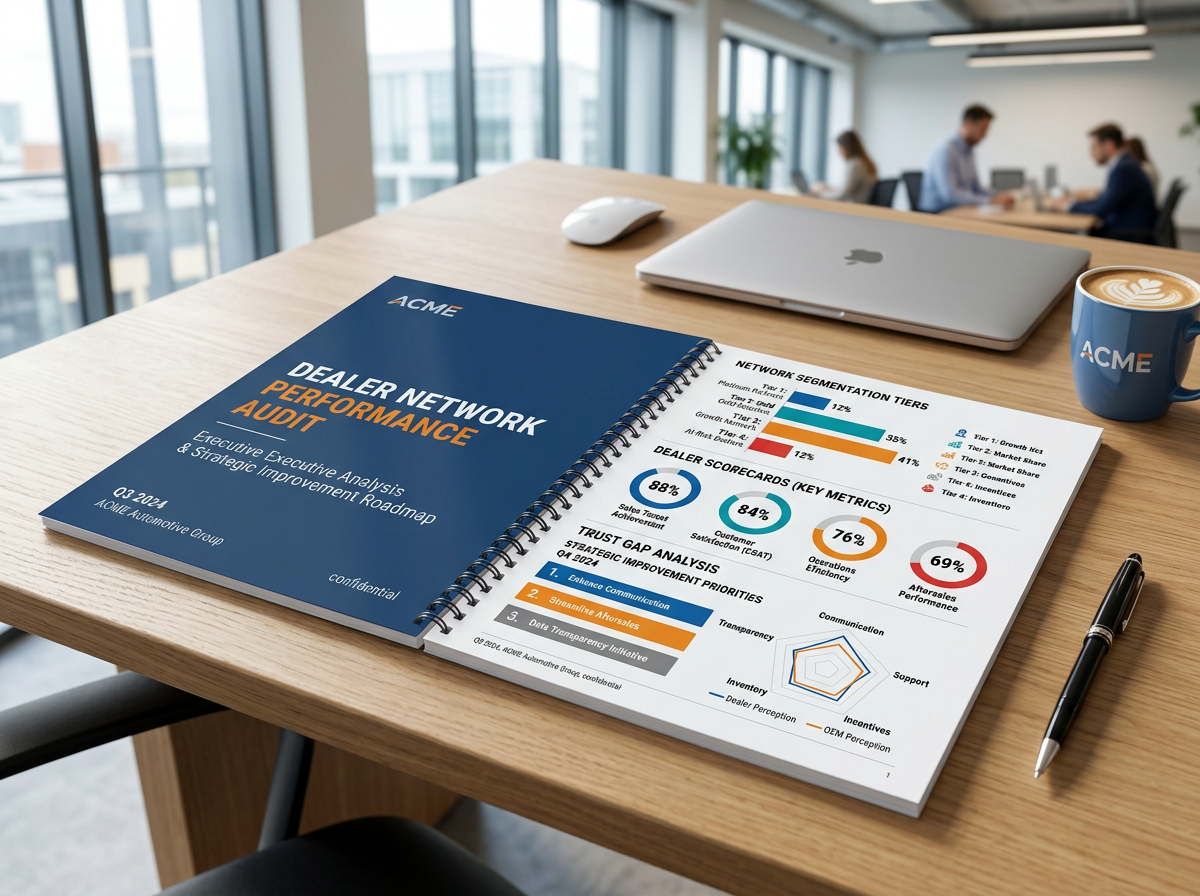
Dealer Scorecard
See how every dealer and market compares
The Dealer Scorecard is the ongoing visibility layer that follows the audit — showing how individual dealers and markets stack up so support can be prioritized by tier, risk, and upside.
It's built for channel teams who need to answer "where should we focus next" without pulling a new report every time.
See how the scorecard worksComing Soon
Built for brands that need clarity before they scale
D2C is currently working with brands across dealer-led categories. Detailed case studies will be published here as engagements complete.
Flooring Brand Dealer Audit
Case study in progress
Trailer & Transport Performance Review
Case study in progress
Local Conversion Improvement Initiative
Case study in progress
Dealer marketing built for performance, not just participation
If you're ready to see which dealers are converting demand and where your network's biggest opportunities are hiding, the audit is the place to start.